Algolancer is a decentralized freelance marketplace that connects businesses and freelancers via smart contracts on the Algorand blockchain, providing on-chain agreements, automated and instant payouts, low fees, high privacy, transparency, and a permanent record of all activity.
Freelancers frequently encounter high platform fees, payment delays, withdrawal restrictions,
and privacy violation.
While Clients struggle to ensure fair compensation, trust a transparent feedback system,
and when desired, make crypto payments without sharing personal payment details.
On Algolancer, no personal information is required at signup or in the future, just an email
to get started and access all features. It also gives freelancers full control over their earnings
through smart contracts logic and P2P payments, no intermediaries or centralized escrow, no paid plans,
minimal fees, instant withdrawals, and full blockchain transparency.
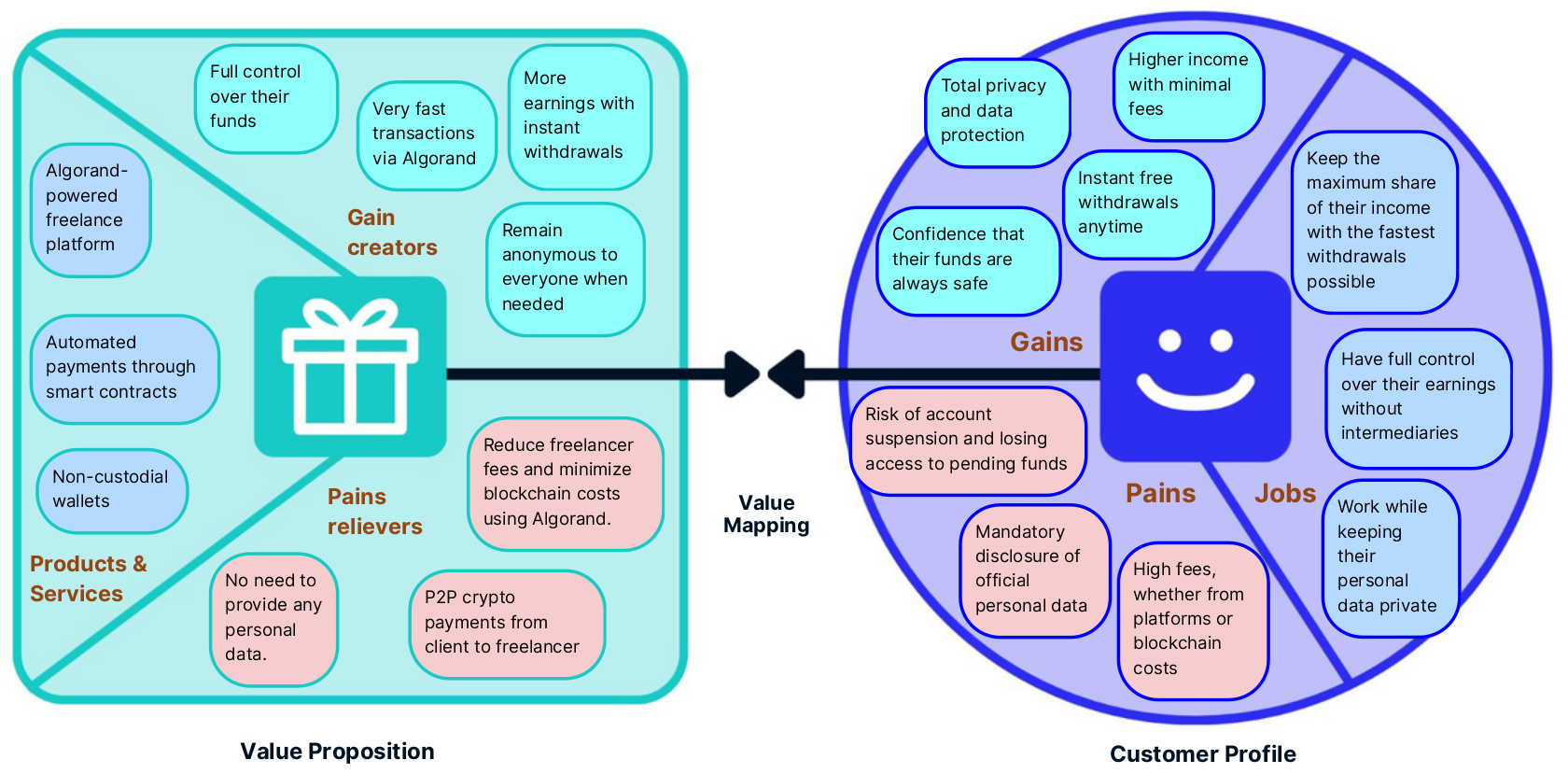
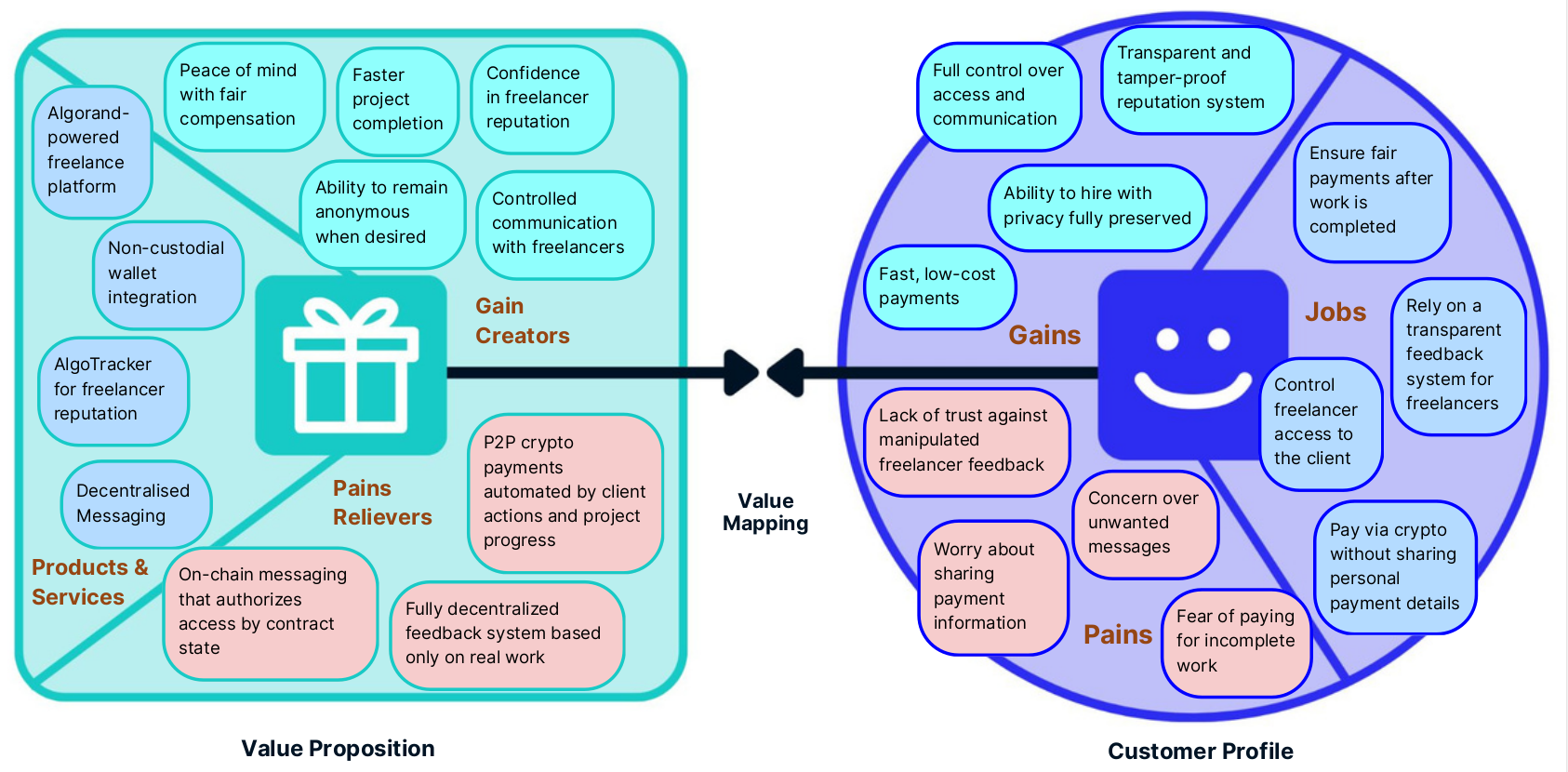
The Value Proposition Canvas below highlights the most significant pain points in the freelance industry and how Algolancer addresses them
Freelancer
Business
Algorand is one of the fastest, most secure, and lowest-cost blockchains in the world.
Created by Silvio Micali, a Turing Award–winning computer scientist, Algorand was designed to be
faster and more cheaper than most blockchains, and since its creation, Algorand nodes have never
experienced downtime.
The blockchain is also designed with post-quantum security, aiming to remain resilient against future
advances in quantum computing.
- Transaction fee = 1000 microAlgo ~ $0.0001
- Transaction confirmation time = 2 ~ 4 seconds
Algolancer is 100% Free to join and use, there are no subscription fees, premium tiers,
or paid plans. Instead, Algolancer follows a pay-per-use model, where users only pay the
relevant protocol fees when utilizing specific services within the marketplace.
Account creation is designed to be as simple and familiar as traditional Web2 applications.
Users can register and log in using their email address and password, without requiring
a web3 wallet.
A wallet is only needed when interacting with the blockchain as part of a project workflow,
such as creating agreements, applying for projects, funding contracts, or approving work.
This approach removes unnecessary complexity while preserving the benefits of decentralization.
User profile data, account settings, and other private information are stored securely off-chain
and are never exposed on the blockchain. Only user activity related to projects and blockchain interactions
is automatically recorded on-chain and permanently preserved as part of the platform's immutable reputation,
ensuring transparency where it matters while preserving user privacy.
An agreement between a client and a freelancer is a smart contract deployed on the
Algorand blockchain. The smart contract escrow holds all project funds and automatically
executes payouts, refunds, and all fund movements according to the contract's logic.
Algolancer never holds user money, funds remain under the control of the smart contract
and no centralized authority has control over the agreement or its escrow.
The platform also does not use custodial wallets, users interact only through self-custody
wallets and retain full control of their funds at all times.
As mentioned before, Algolancer uses self-custody wallets, and users retain full control
over their funds. All payouts are peer-to-peer and sent instantly between the contract
and the user.
Algolancer currently supports three different wallets :
- Pera Wallet: the most popular native Algorand wallet, users can create new accounts or import existing ones. Pera Wallet is supported only on mobile.
- MetaMask: the most popular Ethereum wallet, used via xChain Accounts feature. MetaMask is supported on both mobile and desktop browser extension.
- Coinbase: another popular Ethereum wallet, used via xChain Accounts feature, and supported on both mobile and desktop browser extension.
Algolancer uses native USDC on Algorand as the main payment asset and transaction currency,
ALGO is used to cover network transaction fees.
Users can acquire both assets through Algorand decentralized exchanges such as
Tinyman
or other platforms.
For Ethereum users, ALGO and USDC can be bridged into the Algorand ecosystem using cross-chain
bridges such as
Allbridge
.
Algolancer uses a pay-per-use model, there are no monthly or annual subscriptions,
and all core features are free for use.
A 3% protocol fee from the worked amount is applied
on payments for both client and freelancer. Additionally, fixed fees are charged to reduce
spams, $1.5 for project creation and
$0.2 for applications.
Clients and freelancers can communicate within a project through decentralized messaging. In our decentralized messaging architecture, messages aren’t stored on the blockchain or any external third party, that would be inefficient and unnecessary. However, the process that authorizes a chat between a client and a freelancer is fully decentralized, it depends on the freelancer’s local state within the project and continuously synchronized in real time. More specifically, a chat can be enabled if and only if the freelancer’s state is either “submitter” or “hired”, and the chat session must be initialized by the client.
A cross-chain Account system that allows Ethereum users to control Algorand accounts using their existing Ethereum wallets. (See Ethereum xChain Accounts section).
An on-chain feedback system that tracks user activity from account creation to the present moment, including all interactions, engagements, and platform actions, to build a verifiable and portable reputation history. (See Algo Tracker section).