Algorand uses the Ed25519 digital signature scheme,
a modern public-key cryptography system that provides strong security with fast signature
generation and verification.
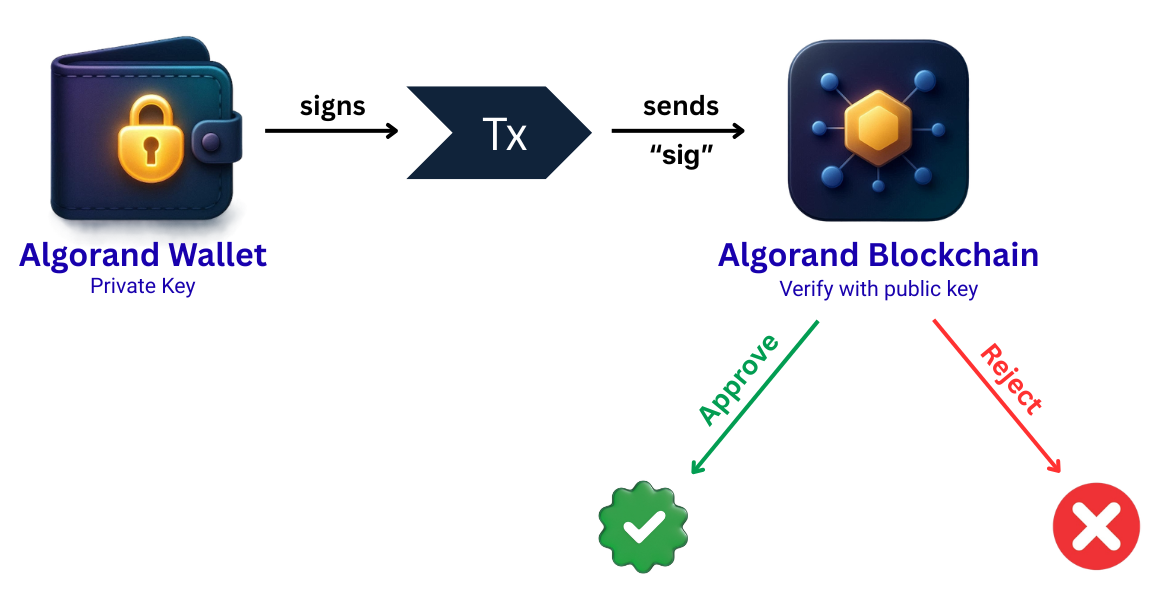
Every Algorand account consists of a public address and a private key, when a user signs
a transaction, the private key is used to generate a unique cryptographic signature
for that specific transaction. The private key never leaves the user's wallet and is
never shared with the network.
When the transaction is broadcast, Algorand nodes use the corresponding public key
to verify that the signature was produced by the owner of the account and that
the transaction has not been modified. If the verification succeeds, the transaction
is accepted, otherwise it is rejected.
In general public-key cryptography, the private key owns the account and is used to
prove ownership while the public key is used to verify that proof. This allows anyone to verify
the authenticity of a transaction without gaining access to the private key itself.
This cryptographic process ensures that only the owner of an account can authorize transactions on the blockchain.
In a Logic Signature (LogicSig), instead of a private-key signature, an Algorand
TEAL program is attached to the transaction. This program defines the rules that decide
whether the transaction is valid or not, and the sender must be the hash of this compiled program.
During on-chain verification, the program is executed and if it succeeds the transaction
is approved, otherwise it is rejected.
In this model, there is no private-key, the TEAL program owns the account, and replaces
the role of a private key in authorizing transactions, while the public-address is the hash
of the compiled program.
Although LogicSig replaces the traditional Ed25519 private-key signature with a TEAL program,
the program is free to implement any authorization logic. This flexibility allows it to verify
signatures produced by other cryptographic schemes instead of relying solely on Algorand
native signature mechanism.
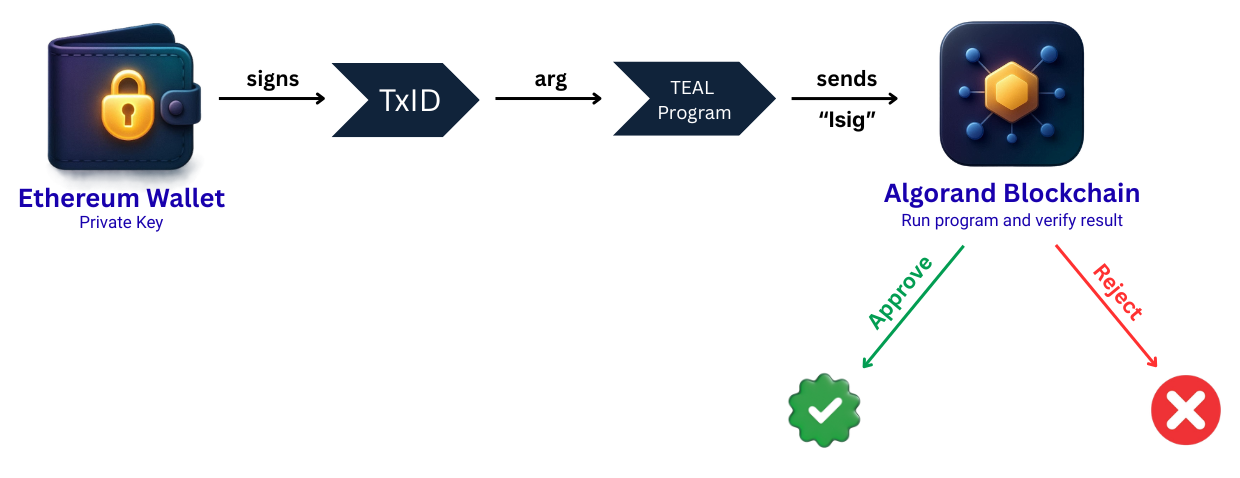
xChain Accounts leverage this capability by embedding Ethereum signature verification inside
the LogicSig program, rather than authorizing transactions with an Algorand private key,
the TEAL program verifies an Ethereum ECDSA signature over the transaction data.
The xChain Account TEAL program is identical for every account and contains the same authorization
logic, the only variable within the program is the embedded Ethereum public-address.
As a result, Each Ethereum account maps to a distinct Algorand account since the program hash
differs based on the embedded public key. The Ethereum ECDSA signature is provided as an input
argument to this program.
During transaction validation, the program verifies that the provided Ethereum signature was
produced by the corresponding private-key of the embedded public-address. If the signature
is valid and was produced by the expected Ethereum address, the program approves the transaction,
otherwise it rejects it.
the Algorand xChain Account is fully owned by the LogicSig program, while the Ethereum
private-key becomes the cryptographic identity used to satisfy the program's authorization rules.
This enables users to control an Algorand account using their existing Ethereum wallet without
ever creating or managing an Algorand wallet.
xChain Accounts can be managed through the Algorand Foundation's
Official xChain Portal
which provides a simple interface for interacting with the associated Algorand account
using an Ethereum wallet.
To get started, users only need to visit the Portal, connect their Ethereum wallet,
and complete the process. Once connected, the portal automatically recognizes
the corresponding Algorand xChain Account and provides access to its information
and available operations. Users can view their Algorand address, monitor account balances,
manage their assets, and perform supported account management actions directly
from the interface.
Every operation is authorized using the connected Ethereum wallet, allowing users to
securely manage their xChain account without creating or maintaining a separate
Algorand wallet. This seamless experience demonstrates the primary advantage of xChain feature:
enabling Ethereum users to interact with the Algorand blockchain through their existing
Ethereum wallet such as Metamask or Coinbase.
Algolancer uses native USDC on Algorand as its
primary payment currency. Therefore, users who hold USDC on Ethereum must bridge
their funds to the Algorand network before they can use the platform, this can be done
through well-established cross-chain bridges such as
Allbridge
and
Wormhole
which support transfers between Ethereum and Algorand. Alternatively, users can fund
their xChain Account with USDC directly from supported exchange platforms such as
Coinbase
and
Binance
where Algorand network withdrawals are available.
In addition to USDC, users must maintain a small balance of
ALGO to pay Algorand network transaction fees. ALGO can also be obtained either
by bridging or by purchasing through the same platforms mentioned above, $1 can cover
up to 10,000 Algorand transactions