A Project is the core unit of work within Algolancer, representing a freelance
opportunity created by a client and secured by a smart contract on the Algorand blockchain.
Each project combines on-chain guarantees with off-chain metadata to provide a decentralized,
transparent, and scalable hiring experience. While project details such as competences, required skills,
categories, and other metadata are stored off-chain for efficiency and flexibility, the project's critical
lifecycle and agreement logic are enforced through Algorand smart contracts.
A project serves as the foundation for all interactions between clients and freelancers,
including applications, hiring, work execution, work unit tracking, and payment settlement.
- Backed by Smart Contract : Every project is backed by an Algorand smart contract that governs its rules, state transitions, and financial operations, enabling automated peer-to-peer cryptocurrency payments while removing the need for intermediaries or third parties.
- Decentralized State Management : Project status, applications, hirings, work progress, timesheet updates, and payment processing are managed through fully decentralized logic rather than centralized platform control.
- Off-Chain Storage : Skills, competencies, categories, and other informational metadata are stored off-chain to maximize scalability and reduce blockchain storage costs
- On-Chain Reputation : Reputation is built from verifiable project activity, completed engagements, and recorded outcomes, creating a portable, transparent and tamper-resistant track record on the blockchain for both Clients and Freelancers.
The following diagram illustrates the project end-to-end workflow in Algolancer, showing how Clients and Freelancers interact throughout the project's nominal scenario, from creation and application submission to project termination.
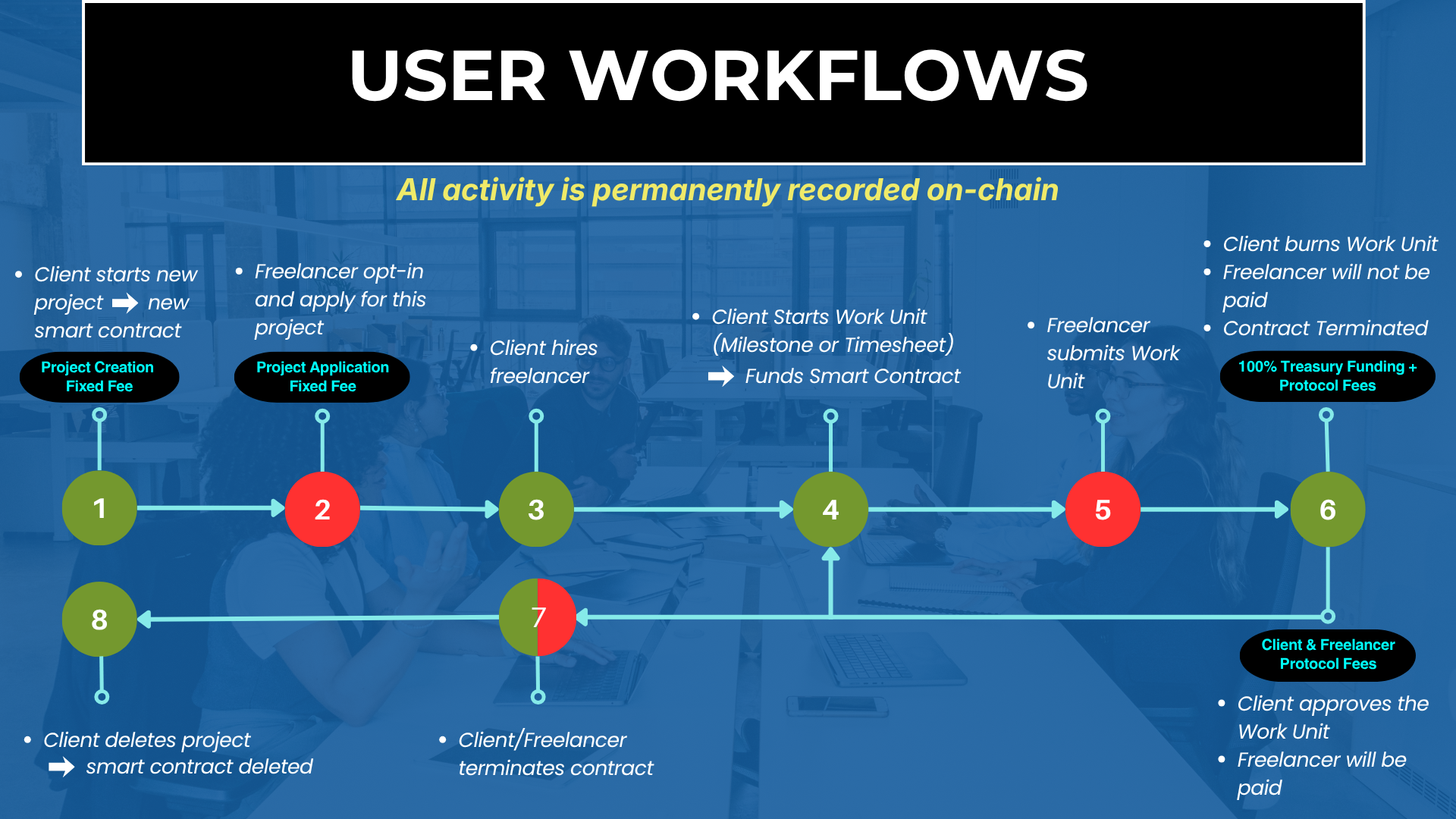
There are two main types of projects within Algolancer:
- Milestone Project : The project is divided into a predefined number of milestones, where each milestone is independent and follows its own workflow, between milestones the client retains the ability to terminate the freelancer contract at any time.
- Ongoing Project : These projects are based on an hourly model using a timesheet system, Freelancers log their working hours along with activity diaries, and the client reviews the submitted data and decides how to proceed.
When creating a new project, the user is required to deposit a refundable collateral amount calculated based on blockchain storage usage (the maximum number of applicants). This amount is fully recovered once the project is deleted.
128 applicants -> ~ 1 644 900 microAlgo ($0.16)
256 applicants -> ~ 3 283 300 microAlgo ($0.32)
512 applicants -> ~ 6 560 100 microAlgo ($0.65)
1024 applicants -> ~ 13 113 700 microAlgo ($1.31)
User is required to pay a second refundable collateral amount of ~203,000 microAlgo ($0.02), which will be returned once the project is deleted.
Also the MBR will increase by ~563,500 microAlgo ($0.05), which will be fully recovered upon deletion.
The real project creation fee is transparent and fixed at 1.5 USDC ($1.50), with no additional or hidden fees.
Once a project is created, it becomes publicly available across the Algolancer network,
and freelancers can view both its on-chain state and off-chain metadata.
To submit a proposal, a freelancer must first opt-in to the smart contract,
and then apply to this project.
The application fee is fixed and transparent, with no hidden costs such as connects or proprietary tokens.
The fee is set at 0.2 USDC ($0.20) per application.
The project owner can view the data of all applicants once they apply to the project. Before making a hiring decision, the owner may initiate a chat session with an applicant to discuss the project and gather additional information. The client can then decide whether to hire or reject their application. A client can hire up to 10 freelancers per project
Once the freelancer is hired, the submitted proposal amount (milestone or hour budget) becomes the agreed work unit budget, and will be used throughout the duration of the agreement.
The next steps depend heavily on the project type and the decisions made by the client. Throughout the project lifecycle, the client may create and fund new work units, terminate an active contract, or delete the project if no active contracts exist. Freelancers on the other hand may opt-out of the project at any time, regardless of the project's global state or their local state within this project.
Important :
If a freelancer opt-out during an active work unit, the locked funds associated with that work unit are not immediately released. Instead, the full amount remains reserved and will be refunded to the client once the project is deleted.
A contract can be terminated in four ways:
- Client termination (default and most common case)
- Freelancer termination
- Client work unit burn
- Freelancer opt-out
For a freelancer, a contract should ideally be terminated by the client, as it positively impacts their on-chain reputation (proof of work).
A project can be deleted by the client at any time, subject to the following conditions:
- No active contracts exist within the project
- The application deadline has been reached
Once the project is deleted, the client can recover any pending funds, as well as the primary MBR and the collateral paid at project creation.